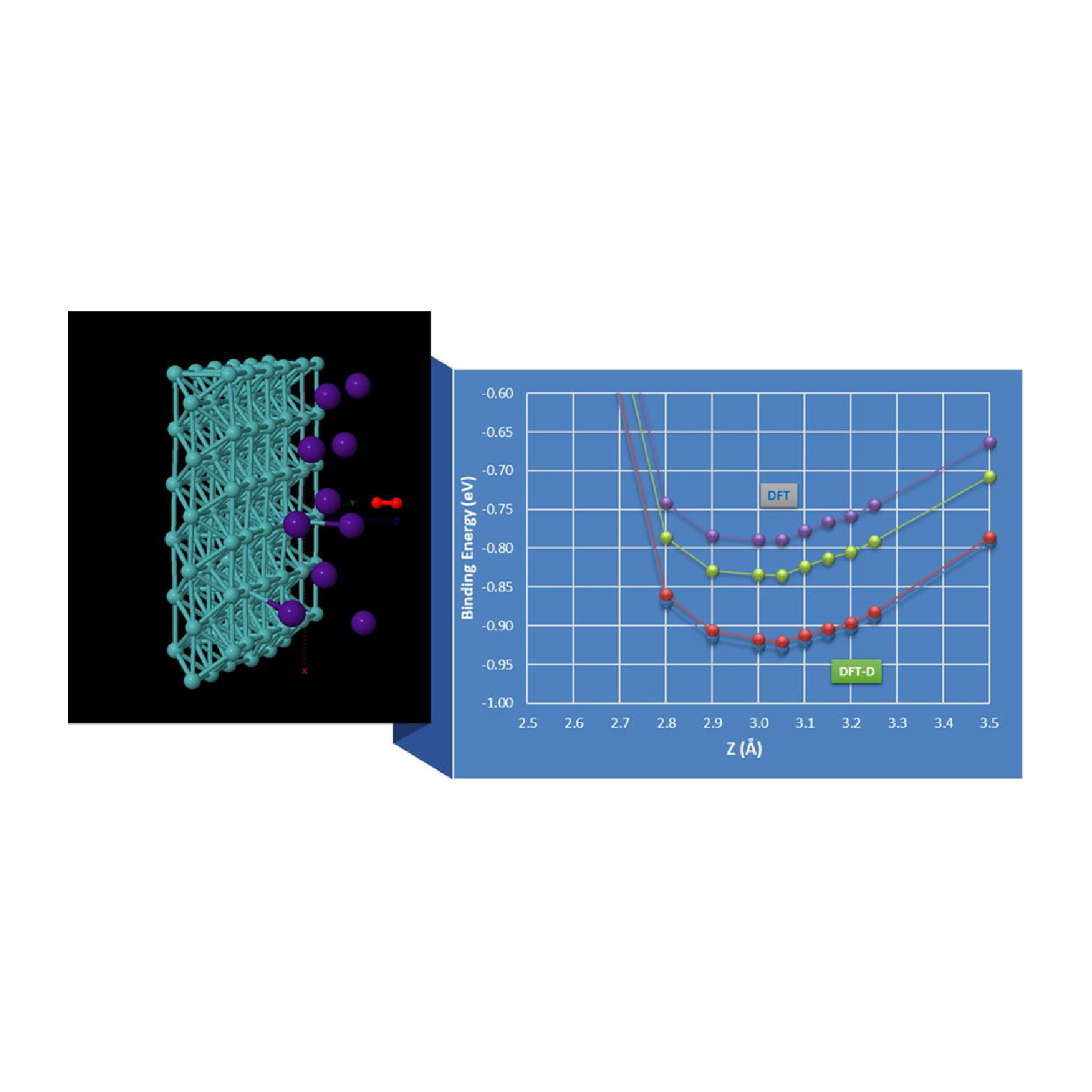
Dispersion energy effects on oxygen interaction with cesiated molybdenum surfaces
Sanna N.; Rutigliano M.; Palma A.
We studied the interaction of a medium coverage cesiated molybdenum surface with atomic and molecular oxygen by DFT-D method for singlet and triplet electronic spin states. Dispersion forces account up to 15% of the binding energies and provide a correct behaviour of the long-range interaction. No curve crossing was observed and the triplet electronic spin state of O/O2, being the most stable, was then considered and used to build a reactive surface of O2 impinging on top of one sampled Cs surface atom. For the considered approaching geometry, the barrier estimated for molecule dissociation is of 1.3 eV.
Related products
-
Fusion engineering and design 166 pp. 112315 - 1 - 112315 - 6 Year: 2021 DOI: 10.1016/j.fusengdes.2021.112315
Cross machine investigation of magnetic tokamak dust: Morphological and elemental analysis
De Angeli M.; Ripamonti D.; Ghezzi F.; Tolias P.; Conti C.; Arnas C.; Jerab M.; Rudakov D.L.; Chrobak C.P.; Irby J.; LaBombard B.; Lipschultz B.; Maddaluno G.
-
Plasma physics and controlled fusion (Online) 63 (8), pp. 085006-1 - 085006-10 Year: 2021 DOI: 10.1088/1361-6587/ac0163
Vibrational excitation and dissociation of deuterium molecule by electron impact
Laporta V.; Agnello R.; Fubiani G.; Furno I.; Hill C.; Reiter D.; Taccogna F.
-
Nuclear fusion (Online) 61 (11), pp. 116068-1 - 116068-21 Year: 2021 DOI: 10.1088/1741-4326/ac21b9
First principle-based multi-channel integrated modelling in support to the design of the Divertor Tokamak Test facility
Casiraghi I.; Mantica P.; Koechl F.; Ambrosino R.; Baiocchi B.; Castaldo A.; Citrin J.; Dicorato M. ; Frassinetti L.; Mariani A.; Vincenzi P.; Agostinetti P.; Aucone L.; Balbinot L.; Ceccuzzi S.; Figini L.; Granucci G.; Innocente P.; Johnson T.; Nyström H.; Valisa M.
English
Italiano